1.Illusion

这标着是简单题,我倒要看看是怎么样的

用detect it easy看了一下并没有加壳
1

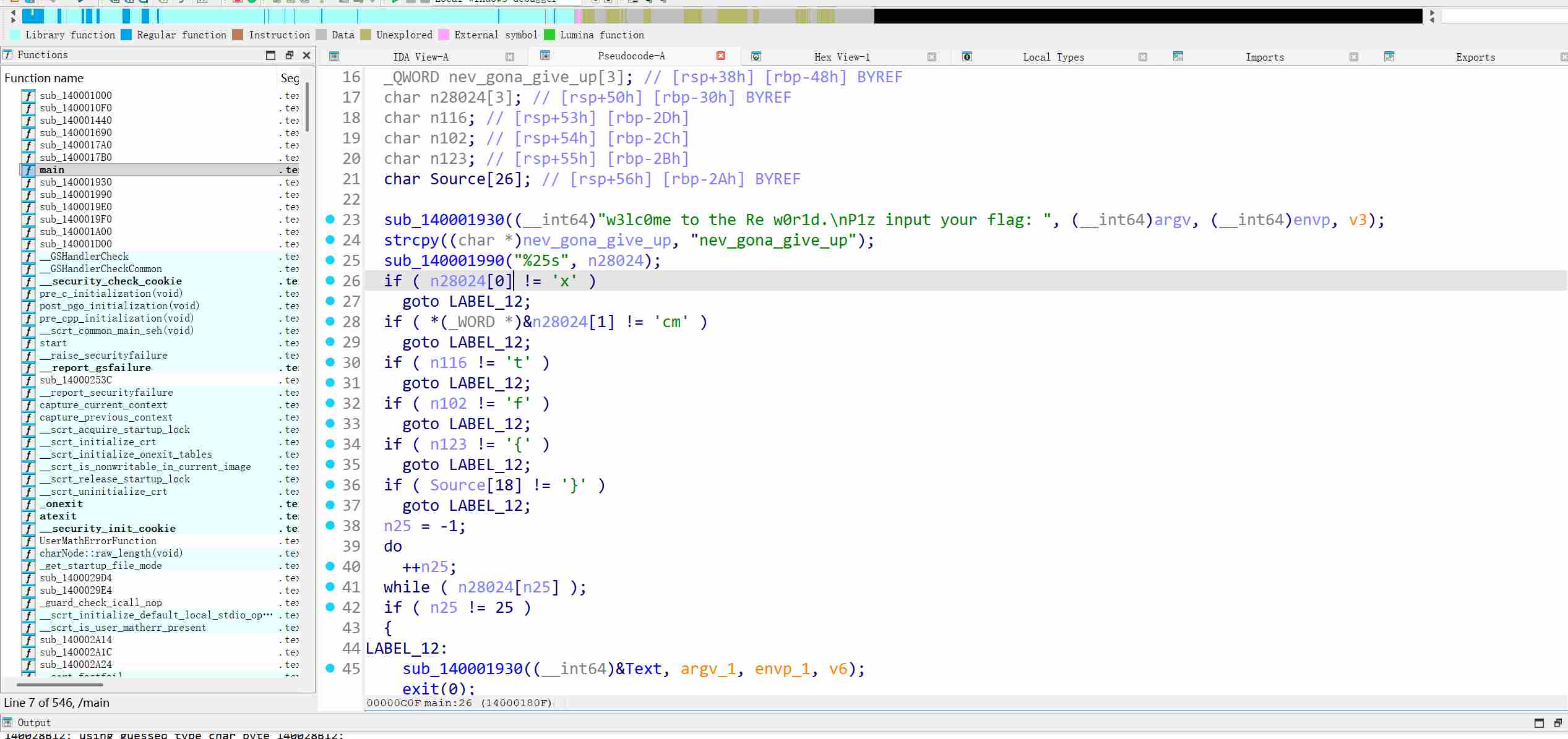
开头就有个字符串验证LABEL_12有exit(0)一看就是有异常退出

所以

1
2
3
4
5
6
7
8
9
10
11
12
if ( n28024[0] != 'x' )
goto LABEL_12;{}
if ( *(_WORD *)&n28024[1] != 'cm' )
goto LABEL_12;
if ( n116 != 't' )
goto LABEL_12;
if ( n102 != 'f' )
goto LABEL_12;
if ( n123 != '{' )
goto LABEL_12;
if ( Source[18] != '}' )
goto LABEL_12;

可以看出来最后一个下标18为}所以猜测字符串长为19

这道题应该有反调试首先是

输入之后直接来这个沉浸在幻术之中吧,那么main函数真的是程序的主逻辑所在吗

题目名称是illusion幻觉

1
2
3
4
5
6
7
8
9
int func(void)
{
return 3;
}
int gi = func();
int main()
{
return gi;
}

c不允许这代码,它不允许常数表达式的函数调用

c规定静态存储期变量必须用常数表达式初始化,函数调用不是常量表达式

执行main/Wmain函数前,c/c++运行时库会进行一系列初始化,
2

在初始化时回到用_initterm与_initterm_,按表顺序遍历并调用,批量调用前置的初始化函数

1
_initterm(&_initterm_ptr, &_initterm_ptr_end)

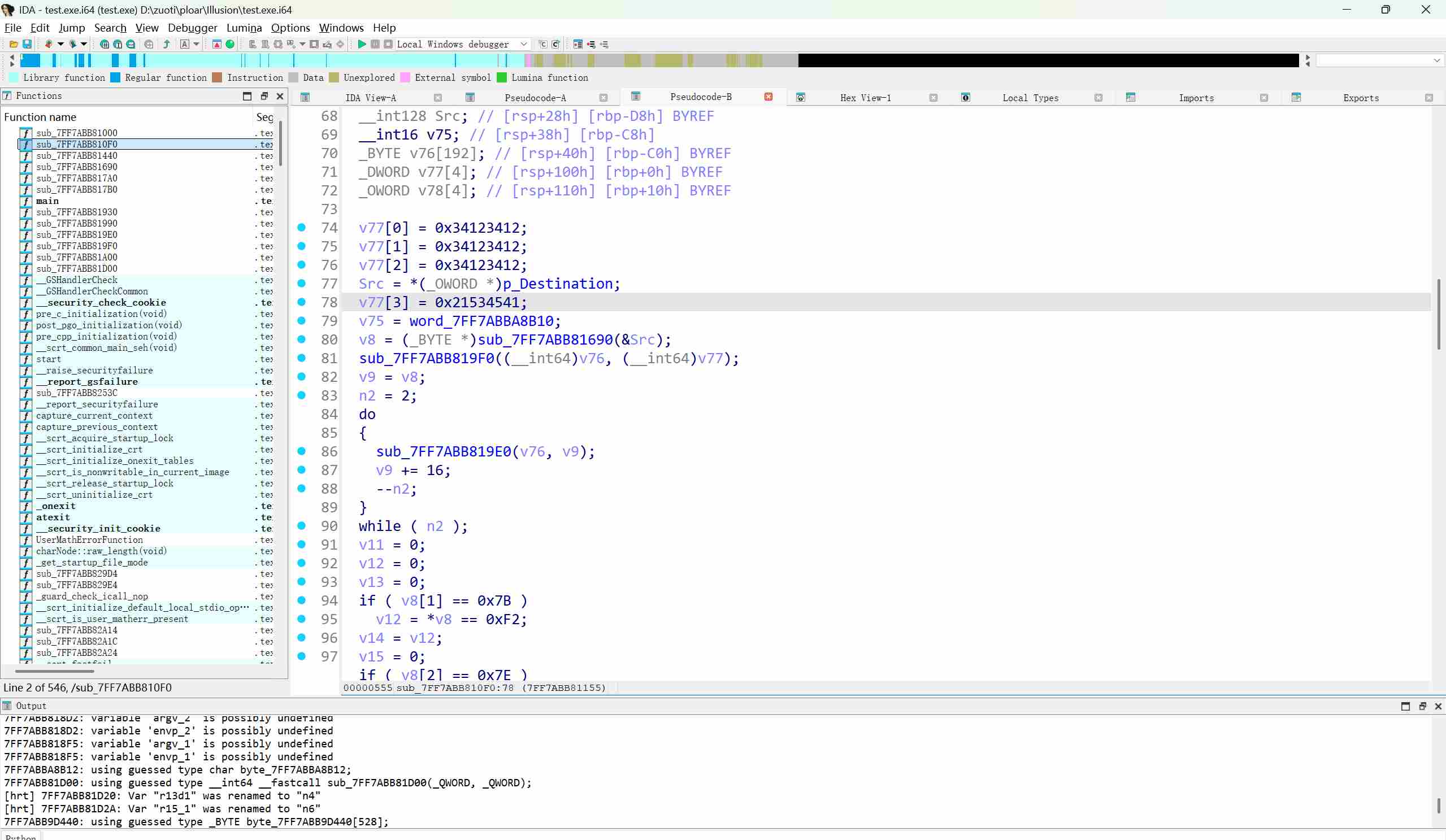
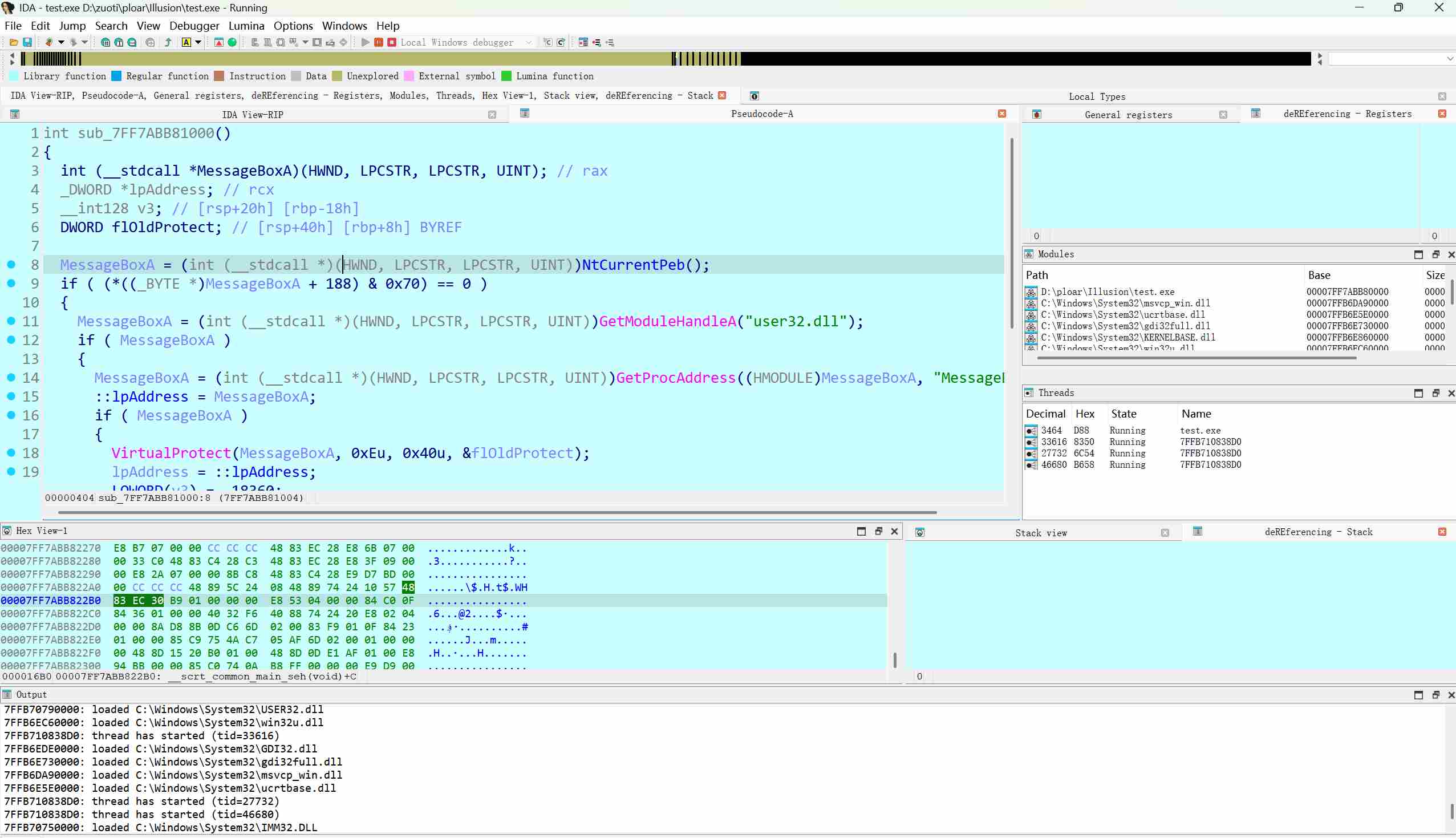
发现调用sub_7FF7ABB81000//这简单题就有inlinehook,发现以前学的还是太浅了

VirtualProtect(MessageBoxA, 0xEu, 0x40u, &flOldProtect)

为什么是0xe这个14字节,因为jmp函数在汇编中jmp指令是ff 25 00 00 00 00 +8字节

指令由操作码(opcode)与操作数组成(oprand)

接着是关键hook函数

1
2
3
4
5
6
7
8
9
10
11
12
13
14
15
16
17
18
19
20
21
22
23
24
25
26
27
28
 MessageBoxA = (int (__stdcall *)(HWND, LPCSTR, LPCSTR, UINT))NtCurrentPeb();
if ( (*((_BYTE *)MessageBoxA + 188) & 0x70) == 0 )
{
MessageBoxA = (int (__stdcall *)(HWND, LPCSTR, LPCSTR, UINT))GetModuleHandleA("user32.dll");
if ( MessageBoxA )
{
MessageBoxA = (int (__stdcall *)(HWND, LPCSTR, LPCSTR, UINT))GetProcAddress((HMODULE)MessageBoxA, "MessageBoxA");
::lpAddress = MessageBoxA;
if ( MessageBoxA )
{
VirtualProtect(MessageBoxA, 0xEu, 0x40u, &flOldProtect);
lpAddress = ::lpAddress;
LOWORD(v3) = 0xB848;
WORD5(v3) = 0xE0FF;
qword_7FF7ABBA8AE8 = *(_QWORD *)::lpAddress;//8字节
dword_7FF7ABBA8AF0 = *((_DWORD *)::lpAddress + 2);//8字节后的4字节
word_7FF7ABBA8AF4 = *((_WORD *)::lpAddress + 6);//8+4+2共14字节
lpAddress_0 = (__int64)::lpAddress;
*(_QWORD *)((char *)&v3 + 2) = sub_7FF7ABB810F0;//16字节后
*(_QWORD *)::lpAddress = v3;
lpAddress[2] = DWORD2(v3);
*((_WORD *)lpAddress + 6) = 0;
LODWORD(MessageBoxA) = VirtualProtect(::lpAddress, 0xEu, flOldProtect, &flOldProtect);
}
}
}
return (int)MessageBoxA;
}

知道提hook在内存中是

0~2字节0x48 0xB8(mov rax, xxx)

2~10字节 sub_7FF7ABB810F0

10~12字节 0xFF 0xE0(jmp rax)

lpAddress是MessageBoxA板块执行流hook到了sub_7FF7ABB810F0函数

MessageBoxA 本身的功能

它就是 Windows 最基础的弹窗函数

1
2
3
4
5
6
int MessageBoxA(
HWND hWnd, // 父窗口句柄
LPCSTR lpText, // 消息正文
LPCSTR lpCaption, // 标题栏
UINT uType // 按钮/图标类型
);

3

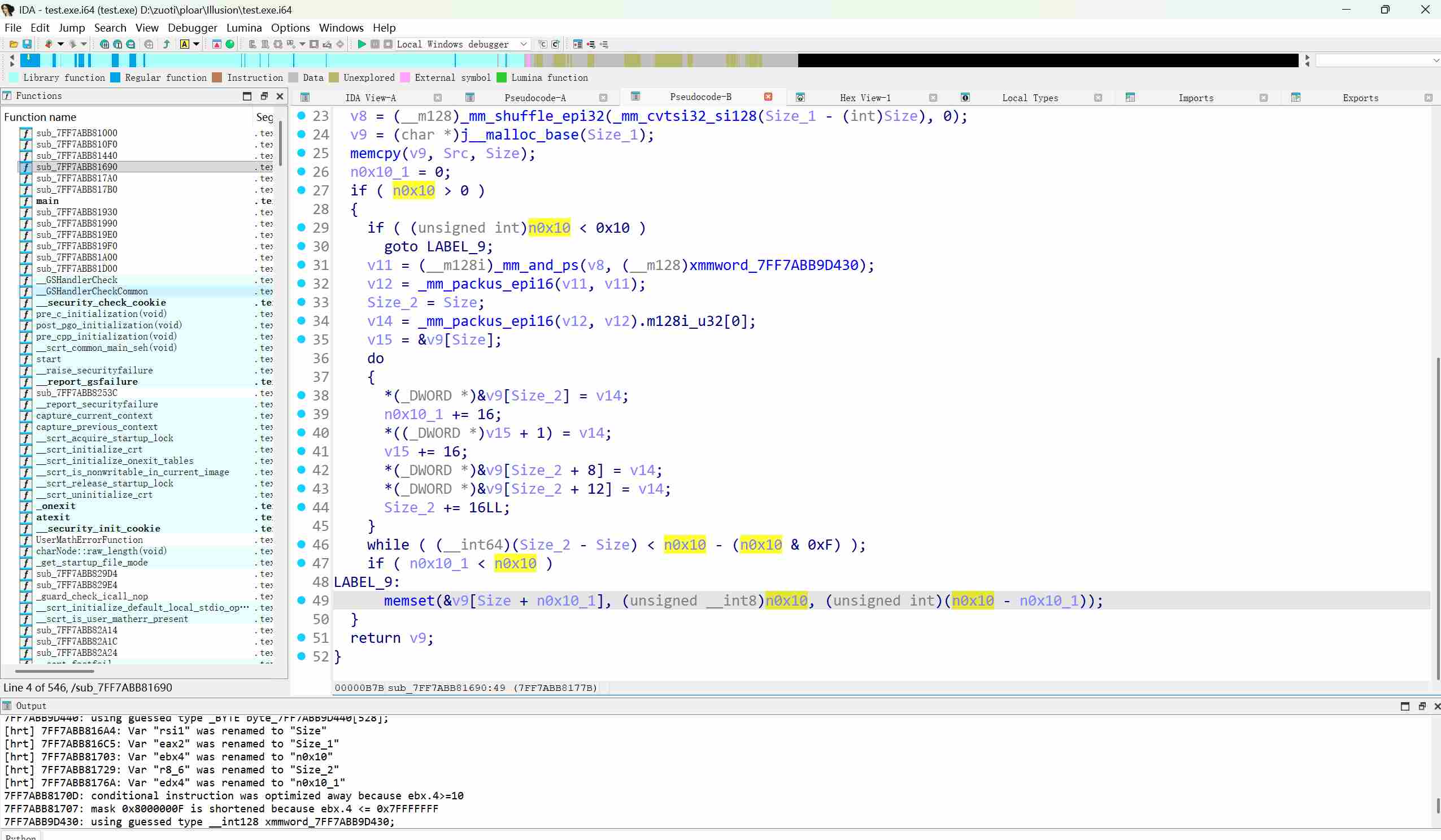
很明显v8对明文进行加密,下面全是对v8的检验,v8一看就是很重要,直接追进去看看究竟是什么
3

进去一看很明显最后是

sub_7FF7ABB819F0((__int64)v76, (__int64)v77);为AES加密

而v77就是密钥,看一眼密钥

1
2
3
4
v77[0] = 0x34123412;
v77[1] = 0x34123412;
v77[2] = 0x34123412;
v77[3] = 0x21534541;

刚好是16字节,128位

memset(&v9[Size + n0x10_1], (unsigned __int8)n0x10, (unsigned int)(n0x10 - n0x10_1));这个明显是PKCS#7 / PKCS#5 填充
缺了多少字节,每个填充的字节就是多少

1
2
3
4
5
6
7
8
9
10
11
12
13
14
from Crypto.Cipher import AES
from Crypto.Cipher.ARC2 import MODE_ECB
from Crypto.Util.Padding import pad, unpad
key = b'\x12\x34\x12\x34\x12\x34\x12\x34\x12\x34\x12\x34AES!'
data = bytes([
0xF2, 0x7B, 0x7E, 0x75, 0xB4, 0x5C, 0x08, 0xFA,
0x19, 0x3C, 0x8A, 0x4A, 0x04, 0xF8, 0x1F, 0x67,
0x1B, 0x05, 0x9C, 0xE7, 0x27, 0x40, 0x78, 0x6D,
0x28, 0xF6, 0xA8, 0xB8, 0x06, 0xC6, 0xC5, 0x51
])
cipher = AES.new(key, AES.MODE_ECB)
decode = unpad(cipher.decrypt(data),16)
print(decode)

题中的部分汇编指令

1.movaps [rsp+48h+var_18], xmm6

将128为的XMM6寄存器保存到栈上(movaps要求16字节对齐,栈帧要严格对其)

2.cdq

符号位拓展,将EAX的符号位复制到EDX的所有位

3.and(位与&)

4.sar r8d, 4

算数右移4(R8D = R8D >> 4(算术右移,等效除以16))

CRT初始化

程序的默认入口点是CRT提供的函数:

控制台程序:mainCRTStartup

程序窗口:WinMainCRTStartup

主要完成

1.操作系统底层对接与安全环境准备(安全环境cookie初始化)

2.操作系统参数的翻译

3.CRT本身核心组件的初始化(Heap init, I/O系统与标准流,区域设置)

4.执行C++全局/静态对象的构造

5.执行main函数

Windows的API

GetModuleHandle:获取模块句柄,获取加载DLL的及地址

GetProcAdress:获取函数地址,从指定DLL中导出函数地址

VirtualProtect:修改内存保护属性,改变一快内存的权限

1
2
3
4
5
6
7
8
Bool VirtualProtect(

[in] LPVOID lpAddress,
[in] SIZE_T dwSize,
[in] DWORD flNewProtect,
[out] PDWORD lpfloldProtect

);

[in] LPVOID lpAddres是访问保护属性的页区域的起始页的地址

[in]SIZE_T dwSize:区域的大小

[in] flNewProtect内存保护选项

  • 0x01 (PAGE_NOACCESS):完全禁止访问。
  • 0x02 (PAGE_READONLY):只允许读取。
  • 0x04 (PAGE_READWRITE):允许读写,但不可执行。
  • 0x20 (PAGE_EXECUTE_READ):允许执行和读取(大多数代码段的默认状态)。
  • 0x40 (PAGE_EXECUTE_READWRITE):允许执行、读取和写入(你用的这个)。

[out] lpfloldProtect指向变量的指针,接受第一页先前的访问保存值(备份原来的值)

inlinehook

通过修改原函数开头的汇编指令,直接跳转到指定函数

## peb

1
2
3
4
5
6
7
8
9
10
11
12
13
14
15
16
17
18
19
20
21
typedef struct _PEB {
BYTE Reserved1[2];
BYTE BeingDebugged;
BYTE Reserved2[1];
PVOID Reserved3[2];
PPEB_LDR_DATA Ldr;
PRTL_USER_PROCESS_PARAMETERS ProcessParameters;
PVOID Reserved4[3];
PVOID AtlThunkSListPtr;
PVOID Reserved5;
ULONG Reserved6;
PVOID Reserved7;
ULONG Reserved8;
ULONG AtlThunkSListPtr32;
PVOID Reserved9[45];
BYTE Reserved10[96];
PPS_POST_PROCESS_INIT_ROUTINE PostProcessInitRoutine;
BYTE Reserved11[128];
PVOID Reserved12[1];
ULONG SessionId;
} PEB, *PPEB;

BeingDebugged检测debugg是返回1

2.FunPyVM

解开attchment(用pyinstxtractor)就看见python程序,这就开启python逆向

pychaos | pyc file | decompile python | pyc to py
python3.13反编译网站

反编译main函数

1
2
3
4
5
6
7
8
9
10
11
12
13
14
15
16
17
18
19
20
21
22
23
import sys
import os
import bitstring
from kernelVM import CustomVM
if __name__ == '__main__':
if getattr(sys,'frozen',False):
current_dir = os.path.dirname(sys.executable)#反回目录部分,打包后
else:
current_dir = os.path.dirname(os.path.abspath(__file__))#源代码(os.path.abspath将相对路径转换为绝对路径

filename = os.path.join(current_dir,'opcode.bin')#path拼接
try:
stream = bitstring.ConstBitStream(filename=filename)#以只读打开文件
bytecode = stream.tobytes()
except Exception as e:
print('Error: Could not read \'opcode.bin\' in the current directory.')
print('Please ensure \'opcode.bin\' is placed next to the executable.')
sys.exit(1)

vm = CustomVM()
print('--- VM Start ---')
vm.run(bytecode)
print('\n--- VM End ---')

getattr(sys, ‘frozen’, False)获取对象的 ‘frozen’属性,不存在返回Fasle

sys是与解释器及运行环境交互的窗口

os是系统库